
Indiana Dunes National Park
The History of Indiana Dunes National Park
Most people picture white-sand beaches when they think of a Great Lakes national park. However, Indiana Dunes National Park offers something stranger and more interesting than a simple stretch of shoreline. Glaciers retreating thousands of years ago carved out the Lake Michigan basin and left behind vast deposits of sand. Since then, wind and water have been rearranging that sand continuously. Today, dune ridges rise up to 200 feet above the water. The landscape also supports such a diverse mix of ecosystems that early twentieth century scientists used this place to develop the foundational principles of plant ecology.
The Birthplace of Ecology
Henry Cowles was a University of Chicago botanist who began studying the dunes in the 1890s. In 1899, he published a landmark paper describing how plant communities change over time as dunes age and stabilize. Scientists now call this process ecological succession. As a result, his work at Indiana Dunes National Park helped give birth to the modern science of ecology. Remarkably, the landscape he studied is still here and still shifting. Walking from the lakeshore inland, you can watch the vegetation change from open sand to grasses, then shrubs, then mature oak savanna and black oak forest. That same succession Cowles documented over a century ago still plays out right in front of you.
The Bailly Homestead
Long before the national park existed, this land served as a crossroads for trade and settlement. Joseph Bailly was a French-Canadian fur trader who established a homestead near the Little Calumet River around 1822. He chose the location deliberately, placing it along well-traveled routes used by Native Americans and European traders alike. Over the following decades, the homestead grew into a small community. Several of the original structures still stand today, including the main house, a fur trading post, and a small cemetery where Bailly and members of his family are buried. It is one of the oldest European settlements in what is now Indiana and one of the more quietly remarkable stops inside the park.
Chellberg Farm
Just a short walk from the Bailly Homestead sits Chellberg Farm, a well-preserved Swedish immigrant farmstead that tells a different chapter of the region’s story. The Chellberg family emigrated from Sweden and began farming this land in the 1870s. They built a brick farmhouse, a barn, and several outbuildings that together paint a detailed picture of rural Midwest life in the late nineteenth and early twentieth centuries. Today, the National Park Service operates the farm as a living history site. For example, maple sugaring demonstrations each late winter draw visitors every year. The farm also hosts a range of seasonal programs that connect people to the agricultural heritage of the dunes region.
The Century of Progress Homes
In 1933 and 1934, Chicago hosted the Century of Progress World’s Fair on the lakefront, showcasing experimental homes built with new materials and construction techniques. After the fair closed, five of those model homes were barged across Lake Michigan and reassembled on the shore near Beverly Shores, Indiana. Together, they represent a remarkable range of styles, from the sleek Florida Tropical House to the futuristic House of Tomorrow, a twelve-sided glass structure that included a garage designed for a small aircraft. Furthermore, the homes still stand today within the park boundary and appear on the National Register of Historic Places. A small number open for tours each year, offering a rare look at how mid-century designers imagined the future of American domestic life.
A Hard-Won National Park
Industry started threatening the dunes almost as fast as people recognized their value. As a result, steel mills, railroads, and the port of Burns Harbor consumed large sections of the western dunes throughout the twentieth century. The fight to save what remained consequently became one of the longest conservation battles in American history. Senator Paul Douglas of Illinois led the charge for nearly two decades. Finally, in 1966, Indiana Dunes National Lakeshore was established, protecting fifteen miles of shoreline. Congress then upgraded the designation to a full National Park in 2019. Today, it is one of the most visited parks in the country and sits less than an hour from downtown Chicago.
Know Before You Go
- Region: Midwest United States
- Location: Porter County, Indiana, along the southern shore of Lake Michigan
- Address: 1215 N SR 49, Porter, IN 46304 (Visitor Center)
- Coordinates: 41.6531, -87.0526
- Costs: NPS Fee $15 – $80 | State Park Fee $7 – $20
- Schedule: Park open year-round; Visitor Center hours vary by season, check the NPS site before you go
- Attraction Type: National Park
- Activities:Swimming, hiking, birding, camping, cross-country skiing, ranger programs, sandboarding on Mount Baldy
- Notes:
- Dogs are allowed on leash on trails and the beach. Summers get crowded fast, so arrive early on weekends.
- The West Beach parking lot fills by mid-morning on hot days. Bring sunscreen, as the open sand reflects a lot of light.
- Indiana Dunes National Park and Indiana Dunes State Park sit side by side but are managed by two separate agencies. Entry fees and passes for one do not cover the other. The America the Beautiful pass works at the national park but not the state park, so plan accordingly.
- Additional Resources: NPS Official Site | Indiana Dunes Tourism
My Visit
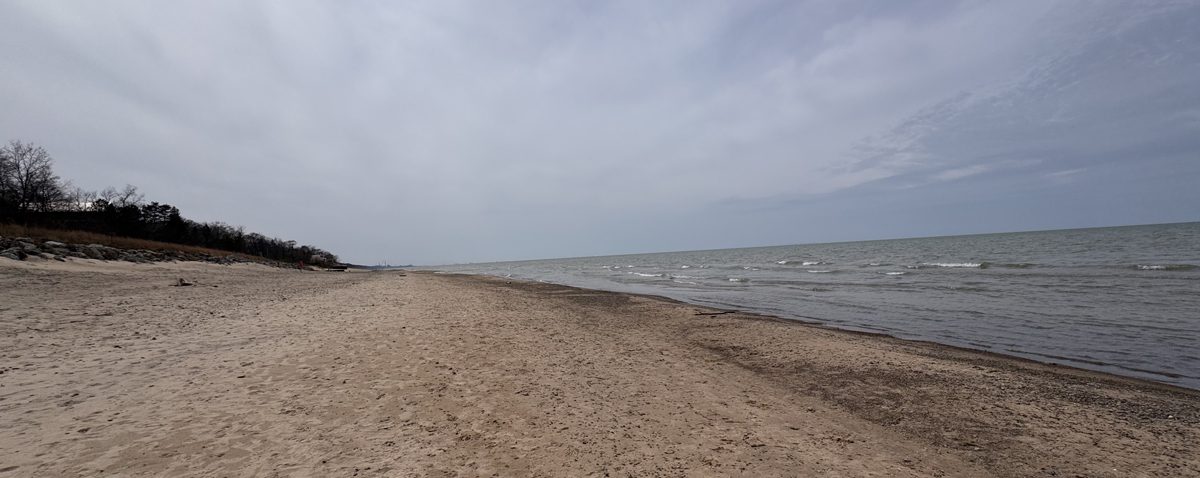
I went in early April with my friend Trish. It was windy and cool but not cold, and gray the whole day. There were some people around but it never felt crowded.
We hit a few of the beach access points along the shore, then drove around looking at the houses up on the lake. After that we went inland to Chellberg Farm and the Bailly Homestead.
Chicago was somewhere out across the water, or maybe that was just clouds. Either way it did not feel like Indiana.
I wrote up the full day on the blog. You can read the whole trip to Indiana Dunes for the longer version.
Photos from my visit.


Indiana Dunes is one of those places that catches people off guard, with towering sand dunes and miles of Lake Michigan shoreline less than an hour from Chicago inside one of the most biologically diverse national parks in the country. If you want more national park units from real visits, there are several others in the Places section.
Monument Rocks National Monument is another Midwest gem most people miss, with ancient chalk formations rising out of the Kansas plains that are free to visit and genuinely striking. Lincoln National Forest in New Mexico is a complete change of scenery, with ponderosa pines and mountain elevation in the middle of the desert Southwest. Castillo de San Marcos National Monument in St. Augustine is the oldest masonry fort in the US and a worthwhile stop if you are ever passing through Florida.
If you want to see everything in the National Park Units section, the full list is here.
The newsletter is where I share the extra stuff: finds, trip notes, and places that do not always make it to the blog. Subscribe on Substack if you want to follow along.
National Park Adventures
The Superstition Wilderness has a way of mesmerizing you with its mystery and its beauty. These mountains sit just east of Phoenix, close enough that you can see…
Day one ended in Sedona. Day two started early, because we had a long way to go and two of the biggest stops on the whole trip waiting…
In the spring of 2006 my brother Alex and I loaded up his Mazda 6 in Arizona and drove home. Not the fast way. The long way, through…
Indiana Dunes National Park had been on the list for a while. A couple of hours from central Illinois, it felt close enough to do in a day…