
Amboy Crater – Amboy, California
A Volcano in the Middle of Nowhere
There is a stretch of Route 66 in the Mojave Desert where the world seems to stop. The towns that once hummed with road traffic have gone quiet. What is left of Amboy sits two miles up the road, where the Roy’s Motel and Cafe sign still stands over an empty lot and a pair of stone lions guard a driveway that goes nowhere. It is out here, just outside the small community of Amboy, California, that a cinder cone volcano rises up from the flat desert floor with no warning and no context. It simply exists, the way old things do, indifferent to everything around it.
The Amboy Crater is estimated to be around 79,000 years old, formed by explosive volcanic activity that pushed ash and cinder skyward and left behind a cone visible from miles in every direction. It is not quite a mountain and not quite a hill. It occupies its own category, sitting alone in the middle of one of the most desolate stretches of the American Southwest, and its size is genuinely deceiving until you are standing at its base.
The Route 66 corridor that runs through this part of California holds remnants of a different era. Amboy itself is one of those remnants, a community that once served travelers crossing the desert and now exists in a kind of suspended state, neither fully abandoned nor fully alive. The crater predates all of it by tens of thousands of years and will outlast whatever comes next.
Know Before You Go
- Region: Southwest United States
- Location: Amboy, California
- Coordinates: 34.5583° N, 115.7784° W
- Cost: Free
- Hours: Sunrise to Sunset daily
- Trail: 3-mile round trip, moderate, natural volcanic surface
- Managed By: Bureau of Land Management
- Attraction Type: Natural Landmark / Roadside
Bring more water than you think you need. The Mojave is unforgiving and there is no shade on the trail. Cell service is limited or nonexistent in this area.
Nearby Places
My Visit
A Trip With Friends
I made this trip in early 2020 with my friends Scott and Jen, meeting them at a pin drop in the middle of the Arizona desert before working our way west through some of the more remote stretches of the Southwest. Scott documents his own adventures over at rsjon.es and this leg of the trip gave both of us plenty to write about.
The Approach
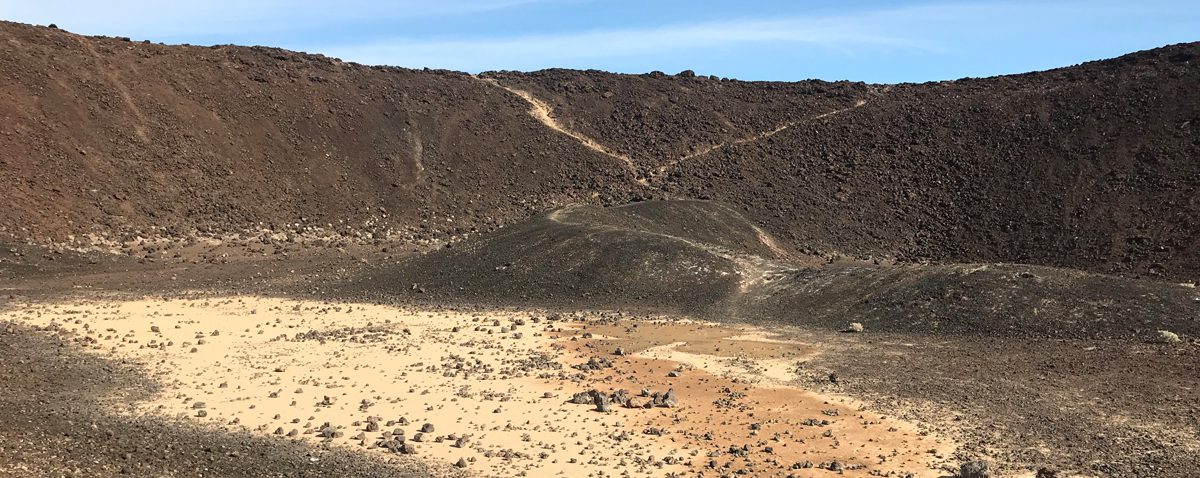
Nothing quite prepares you for how isolated this area feels in person. You can read about the Mojave and understand it intellectually, but standing in it is a different thing. The approach to the crater makes the isolation physical. The trail winds through volcanic rock and sparse desert scrub, and the crater grows slowly as you close the distance, revealing its true scale only when you are nearly at the base.
Standing on the Rim
The climb to the rim is where it changes. Standing on the edge looking down into the interior, and then turning around to look out at what surrounds you, is a specific kind of quiet that is hard to put into words. Below and in the distance sits what is left of Amboy. A handful of structures, a road cutting through, and then nothing in every direction for as far as you can see. It raises a question that I have not been able to shake since: how do people build entire lives out here, and what does that life actually look like day to day. The vastness makes the question feel urgent in a way it would not anywhere else.
Inside the Crater
The interior feels genuinely otherworldly. The lava rock shifts in color and texture as you move around the rim, and the scale of what you are standing on becomes clearer the longer you stay. It is one of those places that earns more the more time you give it.
Worth the Stop
If you are passing through this stretch of Route 66, stop. The crater does not ask for much and gives back more than you expect.
Amboy Crater is one of those Route 66 stops that earns the detour, a 79,000-year-old cinder cone volcano sitting in the middle of the Mojave with almost nothing around it. If you want more roadside oddities and off-the-beaten-path stops from real visits, the Places section has them.
Poston Butte in Florence, Arizona is a free hike up a volcanic mound with a 14-foot masonry pyramid at the summit and 360-degree desert views that most people in the area have never heard of. Sunspot, New Mexico is part solar observatory, part abandoned military installation, and part genuine mystery, sitting at 9,000 feet in the Sacramento Mountains near White Sands. Two Guns, Arizona is another Route 66 find worth knowing about, a dark-history ghost town with crumbling zoo ruins right off the highway.
If you want to see everything in the Roadside Attractions section, the full list is here.
The newsletter is where I share the extra stuff: finds, trip notes, and places that do not always make it to the blog. Subscribe on Substack if you want to follow along.
Roadside Oddity Adventures
During the late 1950s, the commissioning of a spy satellite program marked a significant milestone. The program commissioned the launch of Corona spy satellites from Vandenberg Air Force…
There is a stretch of highway outside Florence, Arizona where the desert flattens out and the horizon opens up in every direction. If you have driven it enough…