

The main drive in is unassuming. A small sign points you to the turn, and then another, and then the signs get bigger and suddenly you are there. Rockets. The complex. It all comes into view at once. For a place that holds so much history it feels almost hidden in plain sight, tucked away until the moment it isn’t.
The opportunity to visit family in Florida and places like Kennedy Space Center had been a long time goal that just never got checked off until now.
My family’s connection to exploration and aviation goes back generations. I caught that bug early. It’s what led me, as a teenager, to Space Camp through the Cosmosphere and Science Center in Hutchinson, Kansas.
While it was not the famous space camp from the 1980s movie fame it was an incredible program. The summer camp sessions are a week long overnight camp. During both years we were assigned to a shuttle crew to instill team building. There were training sessions with your crew and all crews combined, lectures by astronauts, flight time in simulators and so much more. The first year was simply an introduction into it all while the second year you jump in feet first day one as if you had just completed last year’s final mission days before.
During the second year we were loaded onto tour buses and taken down to Houston to visit Space Center Houston. We got to see the Saturn V rocket, the Neutral Buoyancy Laboratory training pool, and walk through a complete mockup training simulator of the International Space Station, among so many other amazing sights. But nothing prepared me for standing in the soon to be retired mission control, the same room where years before the words “Houston, we have a problem” were spoken. We were also lucky to be among the first groups to see the brand new command center built to replace it.
Houston had been as close as I had gotten to the heart of it all. Kennedy had been waiting ever since.
We got there early with a plan. The day was warm but not brutal, which in Florida in April feels like a small miracle.
The plan was simple. Hop the bus first and work our way back to the car from there. The bus is included with your ticket and takes you out to several of the launch sites including LC-39A operated by SpaceX, past the Vehicle Assembly Building, and out to the historic Apollo/Saturn V Center.
One of many highlights of the day was seeing the Crawler-Transporters out and moving. They are not out every day so catching them in motion was something special. What gets me is that these are the same exact machines that moved the Saturn IB and V rockets all those years ago, and have played a role in getting so many people into space. For all their size, moving a rocket to a launch pad is just one small piece in the massive scope of space travel.

The Gantry at LC-39 is set up with a good mix of interactive displays and hands on experiences that kept the kids thoroughly occupied. I found myself less interested in the screens and more drawn outside, out on the balcony with the wind in my face, staring out across a complex so large and so full of history that it is almost hard to take it all in at once.
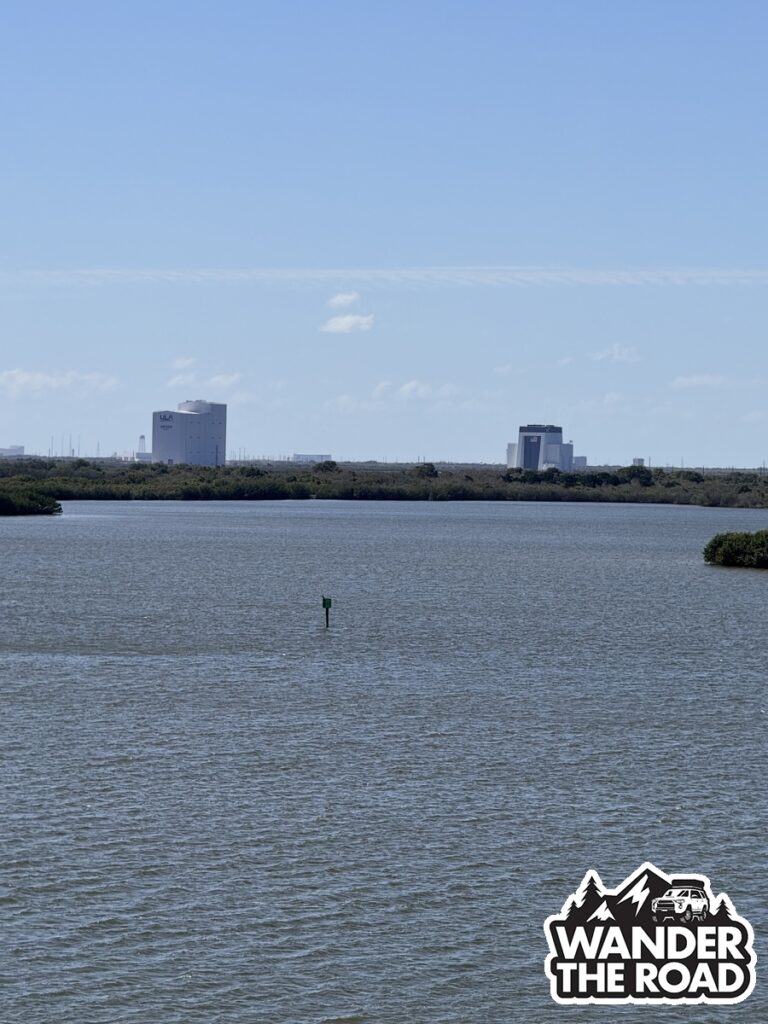
Having a background in computers makes it impossible to stand in front of that technology without stopping to think about what it actually took. These scientists were working with slide rules, pencils, and paper. No supercomputers. No AI. Just hard work, raw intelligence, and an almost incomprehensible amount of determination. Crude and unglamorous by today’s standards, and yet they still managed to do something we have not come close to matching since.
Before you reach the Saturn V itself you are led through a catwalk style viewing area overlooking a recreation of mission control. A brief history plays and then they dim the lights for a simulated launch. The noise fills the room. The building shakes. For a moment you are not standing in a museum at all. Then the doors open and there it is.
Kennedy also has a Saturn V on display, housed inside the Apollo/Saturn V Center. You would never know it was there from the outside. It is a very different experience from the one in Houston where the rocket is one of the main attractions and impossible to miss. Both are displayed horizontally but there is something about stumbling across one tucked inside a building that makes it feel like a discovery rather than a destination.
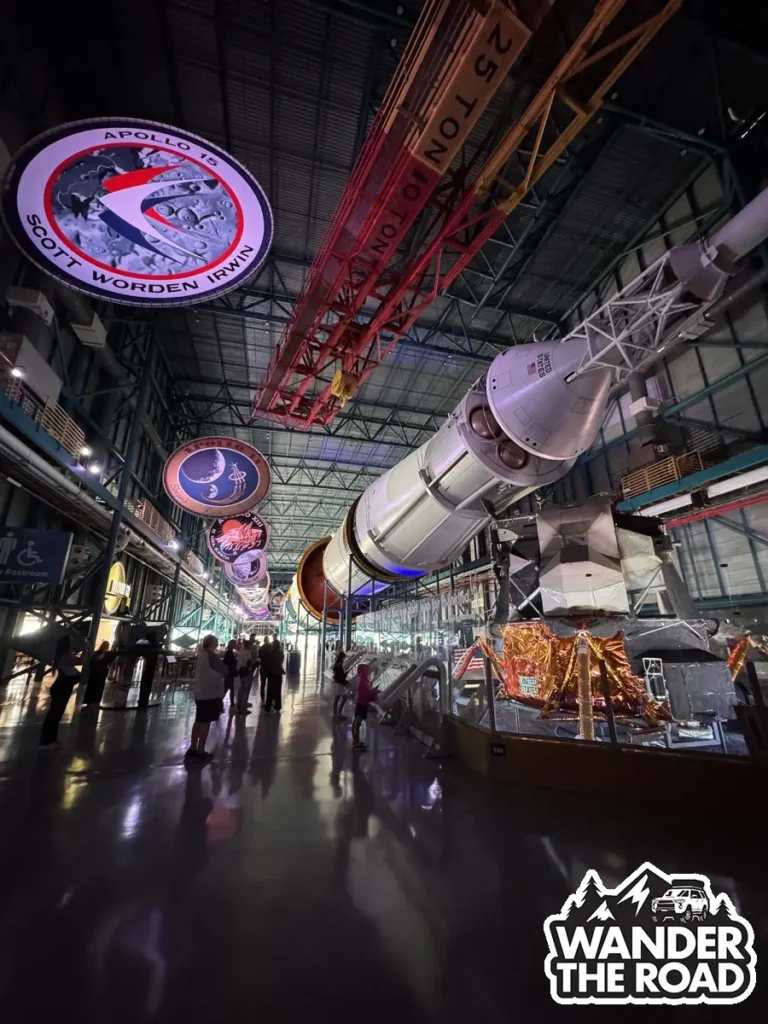
Standing next to the Saturn V puts the whole thing into perspective in a way that photographs never quite manage. The sheer scale of it is almost impossible to process. And then your eyes find the capsule at the top, this tiny compartment, and you realize that three human beings sat up there strapped to all of that, trusting their lives to a stack of machinery and the calculations of people working with pencils and slide rules. It never gets less remarkable no matter how many times you have read about it.
Inside the center there is a diner and a series of exhibit rooms worth taking your time in. I found myself drawn to a section dedicated to the Apollo missions themselves, suits and artifacts and pieces of the actual history laid out in front of you. One thing stopped me completely. An open mission logbook, flight plans with handwritten notes covering the page, and there among all of it a single line that read “Landing in Apollo is a Crash.” Matter of fact. No drama. Just a note in a book that these men were taking with them to the moon.

One of the more fun moments of the day was pointing out to my brother that many of the artifacts and suits on display behind glass were things we had both gotten to experience firsthand at Space Camp. Trying on suits, holding moon rocks, getting hands on with the kind of history that most people only ever get to look at. It gave the whole exhibit a different kind of meaning.
Before making our way to the Hall of Heroes we wound through the Space Shuttle Atlantis exhibit. The approach is deliberate, a long walkway that builds anticipation the way a good theme park queue does, except what is waiting at the end is the real thing. You are led into a large auditorium where a film plays covering the history of the Space Shuttle program, the leap from the Saturn era rockets to something that looked and flew more like an aircraft. It is well done and worth every minute. Then, at the very end, the screen goes transparent and there is Atlantis, just a few feet in front of you. The thought that went into that reveal alone is worth the price of admission. The exhibits surrounding it are just as good.

To end the day the kids headed off to the playground while my mom and I made our way to the Hall of Heroes. You walk into a circular room with a display of rockets at the center and are asked to wait while a video experience plays on the surrounding walls. Then the doors open into a vast hall memorializing every brave soul who has gone into space or given their lives to the program.
Walking through it I kept noticing how many of them were Eagle Scouts. As one myself, there is something about seeing that connection repeated across so many of the greatest names in the history of space exploration that is hard to put into words. These were people who dedicated their entire lives to reaching the top of their fields, all for the chance, not the guarantee, just the chance, to go to space. And those lucky few who did. Standing there with my mom, with our family’s own history with exploration and aviation somewhere in the back of both our minds, the awe of it just settles over you and stays there.
It was busy but never felt packed or Disney World busy. There was room to take your time, stop where you wanted, and just stand in the presence of the brilliance, heroism, and bravery that is around every corner. One could easily make this a multi day trip and still not see it all.
It was a perfect day and a long time coming. Checking it off the list only made me want to go back and experience it all over again.
I believe history will record: that America’s challenge of today has forged man’s destiny of tomorrow. And, as we leave the Moon at Taurus-Littrow, we leave as we came and, God willing, as we shall return, with peace and hope for all mankind. Godspeed the crew of Apollo 17.
— Eugene Cernan, Apollo 17, 1972
Photos From My Trip




If you missed the first part of the Florida trip, start with Exploring the Waterways and Watersheds of Florida. For more historic sites and places worth stopping for, take a look at the Fort Bowie National Historic Site and the Castillo de San Marcos National Monument in St. Augustine, which was also part of this same Florida trip.


